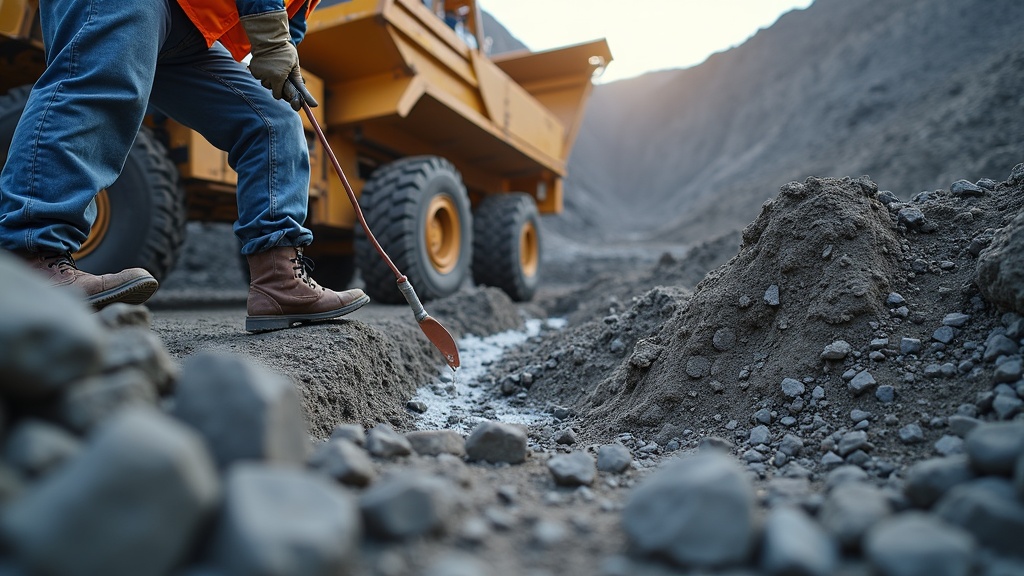
Discover how professional backfill grouting in mining is evolving through digital advancements, improving subsidence control, transparency, and efficiency in underground operations.
Table of Contents
- Key Takeaway
- By the Numbers
- Introduction
- 1. The Science of Backfill Grouting in Underground Mining
- 2. Enhancing Quality Assurance with Immutable Records
- 3. AI and Real-Time Monitoring in Backfill Operations
- 4. Regulatory Compliance and Transparent Reporting
- FAQ: What People Are Asking
- Comparison: Traditional vs. Technology-Enhanced Backfill Grouting
- Practical Tips for Mining Engineers
- Wrapping Up
- Learn More
Key Takeaway: Professional backfill grouting in mining is a critical technique for controlling subsidence and stabilizing underground voids. Digital technologies such as distributed ledgers and artificial intelligence are now enhancing transparency, traceability, and operational efficiency in grout injection, cavity fill, and shaft backfilling projects.
By the Numbers
- 1.0 N/mm² is the typical compressive strength for bulk mine-fill grout mixes used in cavity and mine backfill grouting (Keller Group plc, 2024)[1].
- A water-to-fly-ash mass ratio of 0.8 produces a pumpable yet stable slurry for backfill grouting in coal mines (Journal of Sustainable Mining, 2017)[2].
- Operators repeat the backfill grouting sequence every 10 meters of working face advance to maintain subsidence control (Journal of Sustainable Mining, 2017)[2].
- Pressurized remote grout backfilling stabilized two Abandoned Mine Land sites near Beulah and Zap, North Dakota (American Society of Reclamation Sciences, 2005)[3].
Introduction
Professional backfill grouting in mining has become a cornerstone of modern underground construction and reclamation. As the demand for mineral resources grows, so does the need to manage the voids left behind by extraction. Uncontrolled subsidence can damage surface infrastructure, contaminate aquifers, and create safety hazards. Traditional methods rely on cementitious slurries, fly ash, and bentonite injected under pressure to fill cavities and stabilize rock masses. However, the mining industry is now embracing digital innovations – distributed ledger technology for immutable record-keeping and AI for predictive optimization – to bring a new level of trust and efficiency to these operations. This article explores how professional backfill grouting in mining is being transformed by technology, with a focus on quality assurance, real-time monitoring, and regulatory compliance.
1. The Science of Backfill Grouting in Underground Mining
Backfill grouting in underground mining involves the injection of a pumpable material into cavities, fractured zones, or shafts to provide ground support and prevent surface subsidence. As O. Szlachcic-Cyplik noted, backfilling and injection of granular materials into mining-induced voids is widely used overseas to control mine subsidence (University of Wollongong, 2009)[4]. The grout mixture typically consists of cement, fly ash, water, and sometimes bentonite to achieve the desired flow and strength. J. Denton explained that grouting often uses a fly ash–cement mixture as the backfill material placed to provide support in specific areas (U.S. Bureau of Mines, 1993)[5]. The choice of mix design depends on the void geometry, rock strength, and environmental conditions. For example, a water-to-fly-ash mass ratio of 0.8 yields a stable, pumpable slurry suitable for coal mine backfill grouting[2]. Bulk infill grouting is executed from primary injection holes arranged on a square grid, with secondary and tertiary holes added as needed to achieve full coverage (Keller Group plc, 2024)[1]. This systematic approach ensures cavity fill is complete and subsidence is controlled.
Cave Backfill Grouting and Void Stabilization
Cave backfill grouting implies grouting the caving rock mass before it compacts. Khalid A. Al-Hwaiti described that the filling materials strengthen the caving rock and support overlying strata to slow surface subsidence (Journal of Sustainable Mining, 2017)[2]. This technique is especially relevant in longwall mining where overburden fractures develop. By injecting grout into these separated beddings, engineers create a reinforced zone that reduces the risk of catastrophic collapse. The procedure often uses hydraulic flushing and grouting – identified as the most common remote backfill methods for stabilizing abandoned coal mines[5]. Additionally, pressurized grout remote backfilling has been successfully applied to stabilize undermined roads and buildings, as documented at AML sites near Beulah and Zap, North Dakota[3]. These case studies demonstrate the reliability of backfill grouting in underground mining when executed with proper quality control.
2. Enhancing Quality Assurance with Immutable Records
One of the biggest challenges in professional backfill grouting in mining is ensuring that the injected grout meets specification throughout the project. Traditional paper-based records are prone to errors, delays, and even fraud. Distributed ledger technology offers an immutable record where every batch of grout – its mix design, test results, injection pressure, and volume – can be recorded in real time. Smart contracts can automatically release payments to contractors only when certified proof of grouting is verified. This not only reduces administrative overhead but also fosters trust between mining operators, regulators, and local communities. For example, a mining company using such technology can share a transparent view of its backfill operations with stakeholders, creating a single source of truth for compliance data. Field engineers can instantly verify that a particular void has been properly filled via portable digital interfaces. This level of traceability is especially valuable for meeting environmental and safety regulations.
Moreover, distributed ledgers can integrate with IoT sensors placed in grout holes to automatically log injection parameters. This data, combined with AI analytics, helps optimize future mix designs and injection patterns. The result is a closed-loop system where each grouting cycle improves the next. As the industry moves toward digital twins of mining environments, immutable records serve as the backbone for data integrity. Smart contracts could also manage the supply chain for grouting materials – cement, fly ash, additives – ensuring that only certified sources are used. This reduces the risk of substandard materials entering the mine. For mining firms looking to adopt these tools, exploring specialized training programs is essential. One such resource is the comprehensive component of professional development courses that cover implementation of these technologies effectively.
3. AI and Real-Time Monitoring in Backfill Operations
Artificial intelligence is revolutionizing professional backfill grouting in mining by enabling predictive analytics and real-time monitoring. AI models can analyze data from sensors embedded in grout lines and surrounding rock to detect anomalies, such as unexpected grout loss or pressure changes. When significant grout losses occur, the U.S. Army Corps of Engineers recommends multistage backfilling with accelerators to improve fill efficiency (2017)[6]. AI can automatically trigger such adjustments, reducing the need for constant human intervention. Machine learning algorithms trained on historical grouting data can predict the optimal injection rate, grout consistency, and hole spacing for specific geological conditions.
Furthermore, computer vision systems can monitor the surface above underground operations for signs of subsidence, feeding data back to the AI model. This creates a feedback loop where grouting parameters are continuously refined. According to research on fly-ash slurry backfill grouting in coal mines, operators typically fill every 10 meters of face advance[2]. AI can optimize this spacing based on real-time ground movement measurements, potentially increasing the intervals while maintaining safety. The integration of AI with distributed ledger technology ensures that all decisions and adjustments are logged immutably, providing a complete audit trail. Mining companies can use this data to demonstrate due diligence to regulators and insurers. For those interested in the technical foundations, the referenced study on fly-ash slurry in backfill grouting provides a deep dive into mix design and application[2].
4. Regulatory Compliance and Transparent Reporting
Professional backfill grouting in mining is subject to stringent environmental and safety regulations. Authorities require evidence that underground voids are properly sealed to prevent subsidence and protect aquifers. M. Spychak emphasized that underground voids and shafts must be filled with non-shrink bentonite-cement grout formulated from processing tailings to protect aquifers from acid mine drainage and prevent subsidence (IMWA, 2009)[7]. Blockchain-based reporting systems can automatically generate compliance documents that are tamper-proof and easily verifiable by inspectors. This reduces the administrative burden on mining operators and speeds up the approval process. For example, a regulator can access a blockchain dashboard to see real-time records of grout volumes, injection pressures, and material certifications for any given mine section.
Additionally, transparent reporting builds trust with local communities and investors. In an era where environmental, social, and governance (ESG) criteria are critical for securing capital, being able to prove responsible mining practices is a competitive advantage. Mining companies that adopt immutable record-keeping for their backfill operations can differentiate themselves. The pricing of distributed ledger platforms is becoming more accessible, making it feasible for even mid-sized operations to implement. By combining AI monitoring with immutable records, the industry can move toward autonomous compliance where data flows seamlessly from the grout pump to the regulator’s desk. This not only improves safety but also reduces the cost of audits and penalties. As the technology matures, professional backfill grouting in mining will become a model for digital transformation in heavy industry.
FAQ: What People Are Asking
What is the main purpose of professional backfill grouting in mining?
The primary purpose is to control surface subsidence by filling underground voids left by mining activities. Professional backfill grouting in mining also stabilizes rock masses, protects aquifers from contamination by acid mine drainage, and provides support for overlying infrastructure such as roads and buildings.
How does distributed ledger technology improve backfill grouting quality?
Distributed ledger technology creates an immutable record of each grouting batch, including mix design, test results, injection pressure, and volume. Smart contracts automate payments upon verified completion, reducing fraud and administrative work. This transparency helps mining companies comply with regulations and build trust with stakeholders.
What materials are commonly used in mining backfill grouting?
Common materials include cement, fly ash, bentonite, and water. Fly ash–cement mixtures are widely used. Non-shrink bentonite-cement grouts are used for groundwater protection. The exact mix depends on the project’s strength requirements and geological conditions. A typical water-to-fly-ash ratio is 0.8 by mass for coal mine backfill.
What is the role of AI in backfill grouting operations?
AI analyzes sensor data to predict optimal injection rates, detect anomalies like grout loss, and trigger corrective actions such as multistage backfilling with accelerators. Real-time monitoring combined with AI improves efficiency and safety, while distributed ledgers log all AI decisions for audit trail integrity.
Comparison: Traditional vs. Technology-Enhanced Backfill Grouting
To understand the impact of digital technologies, consider the differences between conventional methods and those augmented with distributed ledgers and AI. Traditional backfill grouting relies on manual record-keeping and periodic inspections, while technology-enhanced operations offer real-time transparency and automated verification. The table below highlights key contrasts.
| Aspect | Traditional Backfill Grouting | Technology-Enhanced Backfill Grouting |
|---|---|---|
| Data Integrity | Paper logs, subject to errors and tampering | Immutable distributed ledger, tamper-proof |
| Quality Assurance | Batch testing and manual sign-offs | Smart contract verification, real-time sensor data |
| Regulatory Reporting | Manual compilation, slow audits | Automated compliance dashboards, instant access for inspectors |
| Cost Efficiency | High administrative overhead, potential rework | Reduced paperwork, predictive maintenance, fewer failures |
As the table shows, adopting distributed ledger technology and AI for professional backfill grouting in mining can significantly improve reliability and trust, while reducing long-term costs.
Practical Tips for Mining Engineers
Implementing a digital transformation in backfill grouting requires careful planning. First, start with a pilot project on a single mine section to test the integration of IoT sensors, distributed ledgers, and AI analytics. Use a water-to-fly-ash ratio of 0.8 as a baseline for coal mine operations, but adjust based on local rock conditions. Second, invest in training for your team to understand both the grouting mechanics and the digital tools. Practical professional development courses on applying AI and blockchain to mine backfilling can be found through reputable industry organizations. Third, engage with regulators early to ensure that your reporting system meets their requirements. Fourth, choose a platform with transparent pricing for enterprise solutions to budget accordingly. Fifth, establish clear metrics for success, such as reduction in subsidence incidents, grout waste percentage, and audit time. Finally, consider partnering with specialized firms that offer end-to-end digital backfill solutions. These steps will smooth the transition toward a more transparent, efficient, and trustworthy professional backfill grouting in mining program.
For more about Professional backfill grouting in mining, see see how professional backfill grouting in mining works.
Wrapping Up
Professional backfill grouting in mining is undergoing a technological renaissance. By combining time-tested injection methods with distributed ledger traceability and AI optimization, mining operators can achieve unprecedented control over subsidence, compliance, and stakeholder trust. The integration of these technologies not only improves safety but also positions the industry for the future of digital resource extraction. To stay ahead, consider exploring training resources available through mining and geotechnical engineering associations and adopting a pilot project today.
Learn More
- Keller Group plc. Cavity and bulk mine fill grouting.
https://www.keller.com/expertise/techniques/cavity-bulk-mine-fill-grouting - Journal of Sustainable Mining. Use of fly-ash slurry in backfill grouting in coal mines.
https://pmc.ncbi.nlm.nih.gov/articles/PMC5727619/ - American Society of Reclamation Sciences. Pressurized Grout Remote Backfilling at AML Sites near Beulah and Zap, North Dakota.
https://www.asrs.us/wp-content/uploads/2021/09/0366-Weiner.pdf - University of Wollongong. Backfill grouting for mining subsidence prevention.
https://ro.uow.edu.au/articles/conference_contribution/Backfill_grouting_for_mining_subsidence_prevention/27686589 - U.S. Bureau of Mines. State-of-the-Art Techniques for Backfilling Abandoned Underground Mines.
https://stacks.cdc.gov/view/cdc/206318/cdc_206318_DS1.pdf - U.S. Army Corps of Engineers. Grouting and Backfilling of Underground Openings.
https://www.publications.usace.army.mil/portals/76/publications/engineermanuals/em_1110-2-3506.pdf - International Mine Water Association. Experience with Backfilling Underground Voids and Shafts.
https://www.imwa.info/docs/imwa_2009/IMWA2009_SpychakExperience.pdf