Learn what RCA cables are, how they work, and how to choose the right ones for your audio setup. This guide covers signal quality, shielding, and common applications for home audio gear.
Table of Contents
- What Are RCA Cables?
- Signal Quality and Shielding
- Common Applications
- Choosing the Right Cable
- FAQ
- Comparison: RCA vs. Other Audio Cables
- Practical Tips
- Final Thoughts on RCA Cables
- Useful Resources
Key Takeaway: RCA cables are analog audio interconnects used to transmit line-level signals between components like turntables, amplifiers, and speakers. For most home setups under 6 feet, a well-shielded RCA cable delivers performance indistinguishable from more expensive alternatives.
RCA Cables in Context
- The global RCA phono connectors market is projected to grow from $1,131.2 million in 2025 to $1,596.4 million by 2033 (Cognitive Market Research, 2025)[1].
- The audio cable market shipped an estimated 1.6 billion units in 2023 (Market Growth Reports, 2024)[2].
- North America’s RCA connectors market is forecast to grow at a CAGR of 9.1% from 2026 to 2033 (LinkedIn Pulse, 2025)[3].
RCA cables have been a staple in home audio for decades. Whether you are connecting a turntable to a receiver, a DVD player to a TV, or a soundbar to a subwoofer, these simple red-and-white plugs are everywhere. Despite their age, they remain relevant in both budget and high-end systems. This article explains what RCA cables are, how they work, what affects their performance, and how to pick the right one for your needs.
What Are RCA Cables?
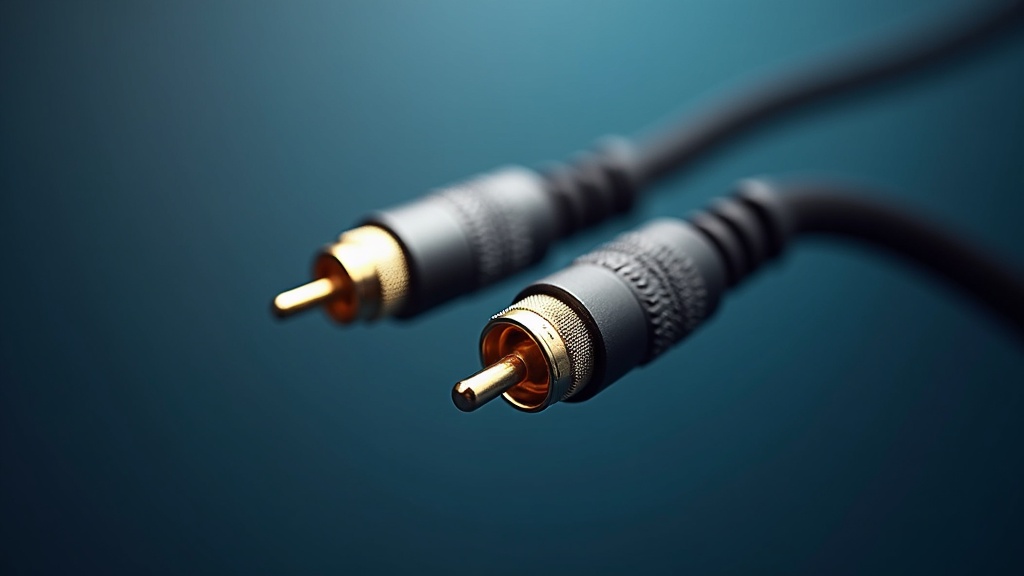
An RCA cable is a type of analog audio interconnect that uses a coaxial design with a central conductor, a dielectric insulator, a shield, and an outer jacket. The connector itself – named after the Radio Corporation of America, which introduced it in the 1940s – features a central pin for the signal and an outer ring for the ground. This unbalanced design is simple and inexpensive, making it the default for consumer audio gear.
RCA cables carry line-level signals, meaning the voltage is already amplified enough to be sent between components without significant noise pickup – provided the cable is well-shielded and not excessively long. As Paul McGowan, co-founder and CEO of PS Audio, notes, “RCA cables are still the primary way most two-channel audio systems are connected, and for line-level signals they can sound every bit as good as balanced connections when they’re properly designed and kept reasonably short.”[4]
For the average listener, a decent RCA cable from a reputable brand will perform flawlessly. The key variables are shielding quality, conductor material (copper vs. silver-plated), and connector plating (gold vs. nickel). None of these matter much if the cable is used within its intended length – typically under 6 feet for line-level signals.
Signal Quality and Shielding
Because RCA connections are unbalanced, they are inherently more susceptible to electromagnetic interference (EMI) and radio-frequency interference (RFI) than balanced connections like XLR. John Calder, Senior Applications Engineer at Neutrik USA, explains: “Unbalanced RCA connections are inherently more susceptible to noise pickup than balanced lines, which is why we always advise keeping RCA runs as short as possible and using good shielding when you’re dealing with low-level analog signals.”[5]
Good shielding typically involves a braided copper or foil wrap around the dielectric. Some cables combine both for maximum protection. In practice, for runs under 10 feet in a typical home environment, even basic shielding is enough. Problems arise only when cables run parallel to power cords or are placed near transformers, Wi-Fi routers, or other noise sources.
Steve Guttenberg, hi-fi reviewer and former CNET columnist, sums it up: “For most home stereo and home theater rigs using typical cable lengths, a well-made RCA interconnect is more than adequate; you’re far more likely to hear differences from speakers, room acoustics, or source quality than from swapping one decent RCA cable for another.”[6]
If you are setting up a simple two-channel system, a standard RCA cable from a reliable brand will serve you well. For longer runs or noisy environments, consider a cable with heavier shielding or a balanced alternative.
Common Applications
RCA cables are used in a wide range of audio and video applications. The most common include connecting a turntable to a phono preamp or receiver, linking a CD player or streamer to an amplifier, and sending subwoofer signals from an AV receiver to a powered sub. In home theater setups, composite video (yellow RCA) is still used for standard-definition video, though HDMI has largely replaced it.
For project-studio musicians, RCA cables are common on mixers, audio interfaces, and consumer-grade gear. Alan Silverman, Grammy-winning mastering engineer and instructor at Berklee Online, observes: “RCA connectors may be an old standard, but they remain fundamental in consumer and project-studio gear – if you pay attention to cable quality, grounding, and reasonable lengths, they can deliver perfectly clean, professional results.”[7]
In the crypto and trading niche, traders often use RCA cables to connect audio gear for market analysis – whether it’s a high-end DAC for listening to financial podcasts or a simple stereo setup for background music while monitoring charts. For more information on setting up your audio gear, check out our services page for trading tools and resources.
Another growing application is in gaming, where players use RCA cables to connect older consoles like the Super Nintendo or PlayStation 2 to modern TVs via composite or component inputs. While not high-definition, these cables preserve the authentic retro experience.
Choosing the Right Cable
When selecting an RCA cable, consider three factors: length, shielding, and connector quality. For runs under 6 feet, any decent cable from a known brand will work. For longer runs (6–15 feet), look for cables with dual shielding (braid + foil) and gold-plated connectors to resist corrosion. Avoid excessively long runs; if you need more than 15 feet, consider a balanced connection or a line-level buffer.
Conductor material matters less than marketing suggests. Oxygen-free copper (OFC) is standard and perfectly adequate. Silver-plated copper can offer slightly lower resistance at high frequencies, but the difference is inaudible in most systems. Ethan Winer, audio engineer and cofounder of RealTraps, puts it bluntly: “People obsess over exotic RCA interconnects, but as long as the cable is well-shielded and not excessively long, its contribution to the overall sound of a system is vanishingly small compared to the influence of speakers, room, and source material.”[8]
Another consideration is compatibility with your equipment. Some high-end components use RCA jacks that are recessed or closely spaced, so a cable with a slim connector body may be necessary. If you need to connect a laptop to a TV or monitor, you might need an HDMI cable instead – check out this HDMI cable buying guide for laptop connections.
For a broader look at audio cabling, read about audiophile cable myths and facts from Sound & Vision.
Important Questions About RCA Cables
Can I use an RCA cable for digital audio?
Yes, but only for S/PDIF digital audio, which uses a 75-ohm coaxial cable with RCA connectors. A standard analog RCA cable may work for short runs, but it is not impedance-matched and can cause signal reflections or data errors. For reliable digital transmission, use a cable specifically labeled as 75-ohm digital coaxial.
Do expensive RCA cables sound better than cheap ones?
For most listeners and typical cable lengths (under 6 feet), there is no audible difference between a well-made $10 cable and a $200 one. The primary benefits of expensive cables are better shielding, sturdier connectors, and longer lifespan. If you have a high-end system with long cable runs or are in a noisy RF environment, a premium cable may help, but for average use, a mid-range cable is sufficient.
What is the maximum length for an RCA cable?
For line-level analog audio, the practical maximum is about 15–20 feet before signal degradation becomes noticeable. Beyond that, you may experience high-frequency roll-off and increased noise pickup. For longer runs, use a balanced connection (XLR) or a line-level buffer amplifier. For subwoofer signals, you can sometimes go up to 25 feet with a good shielded cable.
Are RCA cables obsolete?
No. While HDMI has replaced RCA for video and multichannel audio in home theater, RCA remains the standard for analog stereo connections in turntables, amplifiers, and many studio monitors. The global market for RCA phono connectors is still growing, driven by the resurgence of vinyl and the demand for affordable hi-fi gear. They are not going away anytime soon.
Comparison: RCA vs. Other Audio Cables
Choosing between RCA and other cable types depends on your system, distance, and budget. The table below compares the three most common analog audio interconnects.
| Cable Type | Connection Type | Max Recommended Length | Noise Rejection | Common Use |
|---|---|---|---|---|
| RCA | Unbalanced | 15 ft | Moderate | Home stereo, turntables, subwoofers |
| XLR | Balanced | 100+ ft | Excellent | Professional audio, long runs, studios |
| 3.5mm TRS | Unbalanced | 10 ft | Low | Portable devices, computer speakers |
For most home setups, RCA is the most cost-effective option. If you need long cable runs or work in a noisy environment, XLR is superior. For portable use, 3.5mm is more convenient.
Practical Tips
Here are actionable tips for getting the best performance from your RCA cables:
- Keep cables short: Use the shortest cable that comfortably reaches between components. This minimizes noise pickup and signal loss.
- Avoid parallel power cords: Do not run RCA cables alongside AC power cords. Cross them at 90-degree angles if they must intersect.
- Use color coding: Red is right channel, white or black is left. Stick to this convention to avoid phase issues.
- Check connector fit: Ensure the RCA plug fits snugly into the jack. Loose connections cause hum and intermittent signal loss.
- Consider a DAC: If your source is a laptop, a USB DAC with RCA outputs can improve sound quality dramatically over the headphone jack.
For more advice on audio gear and trading setups, feel free to contact us.
Final Thoughts on RCA Cables
RCA cables remain a reliable, affordable choice for analog audio connections. They are not obsolete, nor are they magical – they are a simple tool that works well when used correctly. Focus on reasonable length, good shielding, and proper setup, and your system will sound great. For further reading, explore our services page for trading tools and resources.
Useful Resources
- Cognitive Market Research. RCA Phono Connectors Market Report 2025.
https://www.cognitivemarketresearch.com/rca-phono-connectors-market-report - Market Growth Reports. Audio Cable Market Report 2024.
https://www.marketgrowthreports.com/market-reports/audio-cable-market-108734 - LinkedIn Pulse. North America RCA Connectors Market Analysis 2025.
https://www.linkedin.com/pulse/north-america-rca-connectors-market-global-analysis-c0hxe - PS Audio. Ask Paul: Are RCA cables good enough?
https://www.psaudio.com/pauls-posts/are-rca-cables-good-enough - Neutrik USA. Balanced vs. unbalanced audio: what engineers need to know.
https://www.neutrik.com/en-us/blog/balanced-vs-unbalanced-audio-what-engineers-need-to-know - Sound & Vision. Do audiophile cables really matter?
https://www.soundandvision.com/content/do-audiophile-cables-really-matter - Berklee Online. Signal flow and cabling basics for mastering engineers.
https://online.berklee.edu/takenote/signal-flow-and-cabling-basics-for-mastering-engineers - Ethan Winer. Audio myths and facts about cables.
https://ethanwiner.com/articles/audio-myths-and-facts-about-cables